

Margaret Marcuson didn’t come to me looking for a publishing deal. She came to me to talk through marketing options for a book she planned to self-publish.
About five minutes into our conversation, I knew we needed to think bigger.
Margaret has spent decades coaching pastors and church leaders through the hard parts of ministry — the burnout, the blurry boundaries, the impossible pressure of shepherding a fractured flock in a politically charged world. She’s not some fly-by-night influencer with a hot take and a big TikTok following. She has decades of experience, two previously published books, a loyal email list with open rates most marketers would sell a kidney for, and a client roster that spans more than 20 denominations across the United States and Canada.
She had everything a traditional publisher looks for. She just didn’t know it.
Seeing the bigger picture
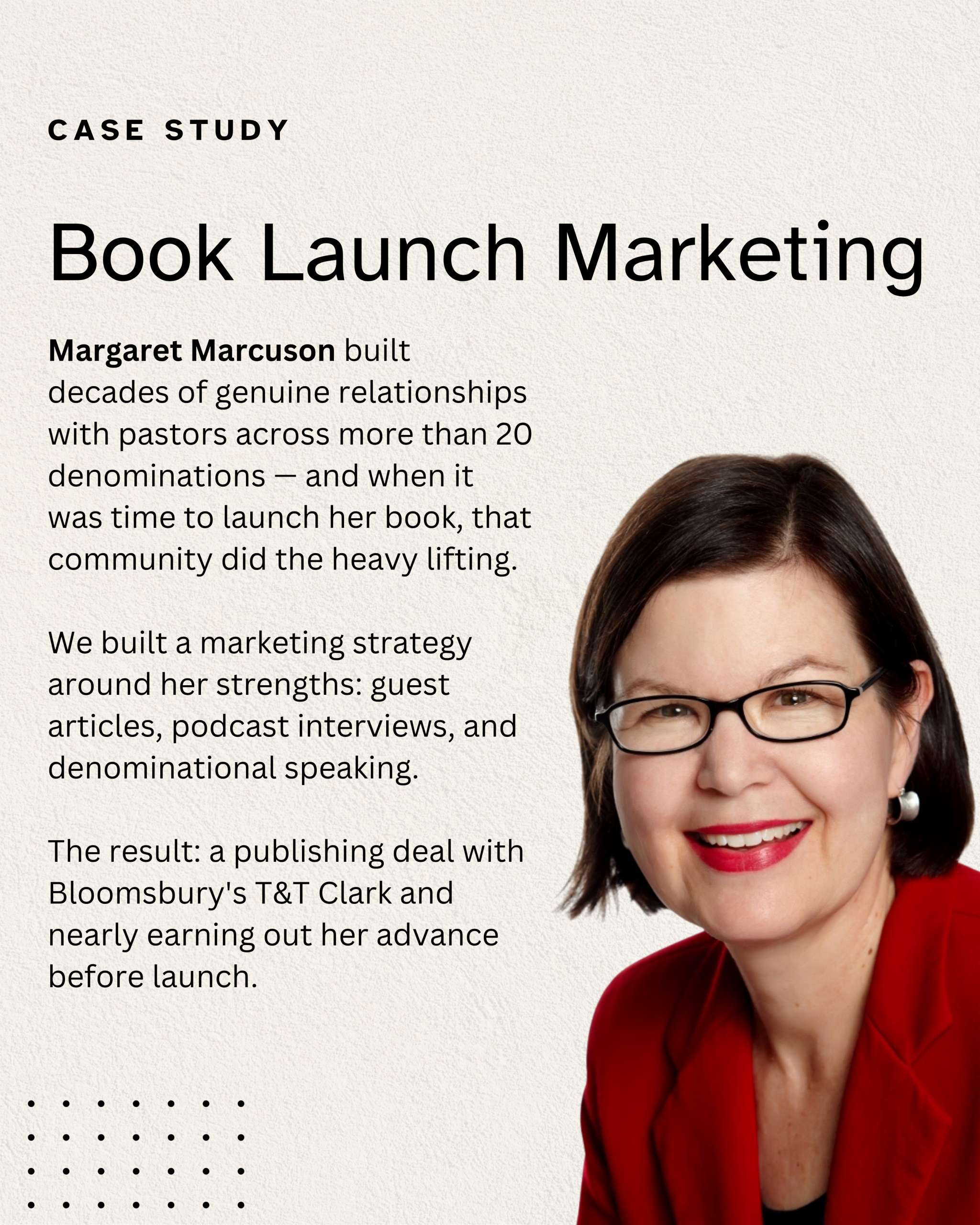 With Margaret’s permission, I reached out to a couple of literary agents in the Christian market to reality-check what I was seeing. They confirmed it: Margaret had the credentials, the track record, and the numbers to support a traditional deal. The best path forward for her niche, they agreed, was to go directly to an academic publisher rather than pursue a traditional trade route through an agent.
So that’s what we did. We worked on her proposal together — not to puff it up, but to make sure it clearly communicated the relevance of her work in the current context. Because the timing couldn’t be more urgent. Pastoral burnout was already a crisis before 2020. After COVID, it got significantly worse. Add to that the pressure many pastors feel to publicly address — or actively resist — the rise of Christian nationalism, and you have a profession in genuine distress. Margaret’s new book, Sustainable Ministry: How to Lead and When to Nap (Bloomsbury/T&T Clark, July 2026) provides a solution.
Sustainable Ministry speaks directly to what so many pastoral leaders are feeling right now: that ministry has never felt harder, that the old playbook isn’t working, and that the weight of it all is crushing them. The book isn’t about technique or strategy. It helps pastors show up more fully for their congregations by first tending to themselves. For leaders who feel like they’re failing at something they were called to do, it’s the book that tells them the truth and gives them a way forward.
Margaret’s offer came after just a few months of queries. And her publisher — T&T Clark — is a perfect match. The Bloomsbury imprint goes back to 1821 and has a reputation for world-class theological scholarship.
What Margaret actually hired me to do
Once the deal was in place, Margaret brought me on to support the book’s marketing and launch, which needed to align with her values and style.
Margaret didn’t want a launch team. She didn’t want a coordinated social media blitz or a 30-day countdown campaign. She’s been around long enough to know that real revenue from a book doesn’t come from book sales. It comes from the doors the book opens. And major ad campaigns and social blitzes don’t usually yield speaking invitations, coaching inquiries, denominational partnerships, or deepen seminary relationships.
And at this point in her career, she’s less focused on revenue than on impact. She wrote the book to save good pastors from burnout so they can continue discipling followers of Christ. The legacy she is building is amplified through those served by the pastors who read her book and live out the advice it offers.
So we built a strategy around what Margaret is actually good at and what her audience actually needs — not around what marketing playbooks say you’re supposed to do.
The strategy we built
We focused on three lanes.
Guest articles. Margaret loves to write, and she has relationships with editors at publications her ideal readers respect. We leaned into that. A bylined article in the right journal does more for a pastor considering her book than a week of Instagram posts.
Podcast interviews. Podcast listeners buy books. Agents and publishers know this. But there’s another reason podcasts made sense specifically for Margaret’s audience: pastors dealing with burnout don’t want to be seen asking for help. They’re not going to show up to a public webinar or join a Facebook group where their congregants might notice. A podcast is private. They can listen in the car, on a walk, wherever. It meets them where they are without making them feel exposed. Margaret also created a playlist of her interviews, a convenience for her (easy to find episodes to share in her newsletter and with hosts she pitches) and for those who want to know more about her and the book.
Speaking and denominational outreach. Margaret has deep roots in theological training programs and denominational associations. A speaking tour is in the works. These are the rooms where her book will get recommended from the stage — which is worth more than any ad spend.
Early feedback from Margaret’s community
You can try your best to engineer an engaged community, but your success is most evident when it comes time to mobilize your members. Here’s a short list of the responses Margaret has gotten from readers in various denominations since Sustainable Ministry launched:
“I’m soaking up every word of your new book. You know how someone says after a sermon in the receiving line: ‘How did you know to say exactly what I needed to hear?’ Well, that’s how reading this book has been for me. I also know the answer to this question has as much to do with the content as it does my being in a place to take it all in.” — Nathan Detering (Unitarian Universalist)
“Working on chapter 3! Finding encouragement to do the things that were already there to be done.” — Chad Parmalee (United Methodist)
“I really appreciate that you recommended reading a chapter a day sitting with the questions. Normally I would have blasted through the book in one sitting. But this challenge is getting me to actually engage with the material and do the work on myself.” — Tom Albinson (Episcopal)
“I’m reading the book. It’s you, and you are good. I enjoy receiving your newsletter, and this is like a whole packet of them on a specific topic: how to be in ministry in the 21st century and stay in love with it. Thanks for writing for those of us who are trying to do this pastoring thing. It’s a help!” — Zach Bay (Baptist)
The real lesson from Margaret’s book launch
Here’s what I want you to take away from Margaret’s story, because it matters regardless of whether you’re a pastor or a product seller or anything in between:
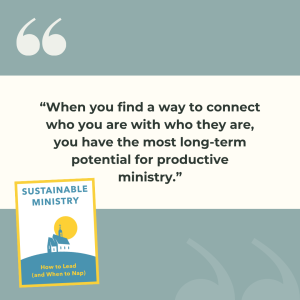
Margaret’s advice for pastors and ministry leaders in her book, Sustainable Ministry, is also great advice for authors who want to connect with their readers.
Margaret doesn’t have a massive social media presence.
She’s barely active on most platforms. Her email list has about 1,200 subscribers — not 12,000 or 120,000. By the metrics most online marketing “experts” would use to evaluate her, she shouldn’t be able to pull off a successful book launch with a prestigious academic publisher.
But she has something that follower counts can’t buy: she knows her people.
She knows that pastors need permission to rest. She knows they carry guilt about their own limits. She knows they’re often isolated in their struggle because their role requires them to project strength. And she has spent her entire career showing up for them in ways that are credible, specific, and genuinely useful. Her people are more than a marketing channel to her. They are a community.
And that community is why her newsletter open rates sit between 40 and 50 percent. It’s why subscribers forward her emails to colleagues and include them in church newsletters. It’s why clients come back to her year after year and why she nearly earned out her advance in preorders alone.
Marketing at its core is driven by relationships. Not algorithms. Not funnels. Not follower counts. Relationships.
Margaret is proof that when you spend years genuinely investing in the people you serve, the marketing part becomes a matter of showing up and letting what’s real speak for itself.
That’s the kind of strategy I love to build. And those are the clients I love to work with.
Interested in Margaret’s book? Get it here from the publisher or order it from Amazon.
And if Margaret’s story sounds familiar — the part about having spent years building something real and not quite knowing how to translate that into a marketing strategy that fits — I’d love to talk.
I work with people who have done the work, know their audience, and are ready to grow in a way that feels true to who they are. Reach out here and let’s figure out what that looks like for you.




0 Comments