The “riches are in the niches” might be Pat Flynn’s most famous quote, and for good reason.
When a business owner or content creator hyperfocuses on a specific area of expertise, they can offer distinct value to their customers in a way that sets them apart from competitors.
Translation: When you niche down, you’ll get even better at what you do and will become an industry leader.
What Trite Rhymes Ignore
That’s not wrong and yet there are nuances in today’s business world that get ignored by such absolutes.
For years, I struggled with my own niche as an online community strategist. Back in 2007, when I made my personal passion a professional one, online community wasn’t even known as a noun. We knew of online forums, message boards, and even comments sections of online publications. But people didn’t think of them as communities. If anything, they were compared to public bulletin boards as if two-way interaction wasn’t possible.
It’s taken years of experience, the development and evolution of social media, and a body of research into online user behavior and belonging to position internet relationships as having value equal to (even greater than) the ones forged in real life.
Community Management: Niche or Industry?
Kathi Lipp, best-selling author and creator of the Clutter Free Academy podcast, stands with Online Community Strategist Tonya Kubo, founder of the Clutter Free Academy Facebook group.
Today, not only are there several online experts specializing in community, it’s a decent-paying job in the corporate world. LinkedIn sends me about a dozen community management job listings each week, most of which pay more than $50,000/year.
The very nature of being an online community expert defies traditional niche boundaries but it doesn’t stop people from trying to box me in further. Someone is always “coaching” me to:
Focus on a specific platform (Circle, Facebook, MightyNetworks, etc)
Focus on paid memberships or only on membership churn
Focus on turning free prospecting groups into sales machines
Choose a specific industry (health and fitness, homeschooling, online courses, publishing, etc.)
The list goes on…
Though I resist, it’s not out of stubbornness. Anyone who doesn’t understand “online community” as a niche unto itself is missing the point. And while I could educate them, I’d much rather spend my time and energy helping business owners like you design and develop a community that gets the results you want.
I only have so many hours in a day. And you, the person who gets what I do and why I do it, is much more important than the one who doesn’t. #sorrynotsorry
Kathi was the first client to ask me to design a community for her and trust me to do it my way.
Though it will always carry her name, the Clutter Free Academy Facebook group has been my baby since I first sketched out its purpose, promise and structure in 2016.
I started appearing on the podcast in 2018, showing up as the public representative of our community. Our cluttery peeps are mired in fear, guilt, and shame. They need both an ambassador and advocate, roles I treasure fulfilling while Kathi serves as their leader.
While the announcement post has gotten over 100 positive comments, a few private messages from business contacts have cautioned me against getting known for “the wrong thing.”
But the way I see it, co-hosting Clutter Free Academy doesn’t carry the risk of being known as a “clutter expert” because anyone who listens or talks to me about it quickly discovers that I’m there as an expert on the vibrant community we’ve cultivated over the years.
How You Can Leverage Your Own Expertise
Consider your expertise — whatever it is — a niche in itself. While you may need to laser in on specific facets of your expertise for thought leadership articles or products you want to sell, don’t feel pressured to narrow your focus unnecessarily. Having a broad understanding of your subject matter is a strength, not a weakness.
Here are some practical ways to leverage it effectively:
Create a Knowledge Map — List all areas of your expertise, including overlaps and connections between them. Identify how these areas complement each other and provide unique insights. Use this map when planning out content and offers. Focus on the unifying principles more than the differences.
Cross-Pollinate Ideas — Actively look for ways to apply insights from one area of your expertise to another. Share these novel connections in your content to demonstrate the value of your broad perspective.
Craft Versatile Case Studies — When showcasing your work, highlight how your broad knowledge contributed to success. Demonstrate how understanding multiple facets of a problem led to more comprehensive solutions.
Collaborate Strategically — Partner with specialists in areas adjacent to your expertise. These collaborations can lead to unique offerings that combine depth and breadth.
Your broad expertise is a unique selling point. It allows you to see connections and solutions that others might miss. By strategically showcasing and applying this comprehensive knowledge, you can provide exceptional value to your clients or organization while standing out in your field.
Are you one of the many entrepreneurs who break out in a cold sweat at the mere mention of financial reports?
As business owners, we often wear our ability to “wing it” as a badge of honor. We pride ourselves on our creativity, our ability to pivot, and our knack for making things work against all odds. But there’s one area where winging it can lead us down a dangerous path: our finances.
I’ll admit it – I used to be that entrepreneur who hid from her numbers. The mere thought of looking at financial reports made my palms sweat. P&Ls? Balance sheets? Cash flow statements? They might as well have been written in hieroglyphics.
Unfortunately, avoiding our finances doesn’t make them go away. In fact, it often makes things worse.
In a recent episode of The Business You Really Want, I sat down with operations expert Gwen Bortner to discuss this very topic. And let me tell you, it was an eye-opener.
Here are a few key takeaways:
Numbers are just data points. There’s nothing actually emotional about the numbers. The emotion comes with how we perceive the number. When we strip away the emotion, we can see our finances for what they truly are: valuable information about our business.
You don’t need to be a math whiz. If you’re using any sort of automated accounting system, it’s doing all the math for you. If you can dial a phone, you can read a financial report. It’s that simple.
Regular check-ins are non-negotiable. Review your reports at least once a month. This helps you spot trends, identify patterns, and make informed decisions.
Profitability isn’t just about sales. It’s your revenue minus the cost of delivering your products or services. As Gwen points out, some businesses grow quickly in terms of revenue, only to realize they’re losing money on every sale.
Why Business Numbers Matter
Understanding our finances is key to building sustainable, fulfilling businesses. It’s about having the information we need to make smart decisions, to grow strategically, and to create the businesses we really want.
If you’ve been avoiding your finances, I encourage you to take that first step. Look at your numbers. Ask questions. Seek help if you need it. Remember, you’re not alone in this journey.
And if you want to dive deeper into this topic, I highly recommend listening to our full discussion on the podcast. Trust me, if I can confront my financial fears, so can you. And the clarity and confidence you’ll gain? Priceless.
As a marketing strategist and online community builder, I’ve always prided myself on my ability to get things done. But when it came to delegation, I hit a wall. Sound familiar?
In our latest episode of The Business You Really Want, co-host Gwen Bortner and I tackle this common entrepreneurial challenge head-on. Today, I want to share my past failures with delegation and the insights I’ve gained along the way.
The Myth of the Perfect VA
I’ll never forget the day I complained to Gwen about my “perfect” VA who just couldn’t seem to become my right hand in business. Gwen pressed me on my effectiveness as a leader. Ouch.
The truth is, I was falling into a common trap: expecting mind-readers at every price point. I’d give instructions thinking, “I don’t care how you do it, I just want it done,” only to be frustrated when the result was the bizarro world version of what I wanted.
The Breakthrough: Understanding True Delegation
Working with Gwen, I’ve learned that true delegation is more than the single act of handing off task. It’s about transferring responsibility.
What delegation actually looks like in practice
Understand the task yourself
Train in stages, checking for understanding
Hand over full responsibility
Hold accountable, allowing for problem-solving
The key? Recognizing that different doesn’t mean wrong. As Gwen pointed out, “There’s lots of right answers, and your right answer may not be the only right answer.”
In my case, I was dropping the ball somewhere between Step 2 and 3. I’m a highly effective trainer, frequently praised by team members for how well I transfer knowledge. What I wasn’t good at, however, was empowering remote workers to be successful —I failed to tell them on the front end that self-sufficiency was the goal. When I handed over full responsibility, they struggled to own the role and graduate from task-level mastery to ownership.
Overcoming the Fear of Letting Go
Gwen’s clients, on the other hand, usually struggle with the fear that no one can do things quite like them. Sound familiar? Here’s our advice to overcome this:
Approach with curiosity. Instead of assuming the worst, ask “Why did you choose to do it that way?”
Allow for learning. Sometimes, letting someone try their way (even if it doesn’t work) leads to faster learning than simply telling them what to do.
Focus on outcomes: As long as the end result meets the standard, the exact method matters less than you might think.
The ROI of True Delegation
Embracing these principles can transform your business and your satisfaction as a business owner. Personally, the subtle changes I’ve made in my own own approach to delegation have led to major results. When you delegate effectively, you will then be able to:
Spend more time focused on high-level strategy
Experience a team that brings their best ideas to the table (you now have thought partners)
Scale your business without burning out
The Bottom Line
If you’re struggling with delegation, know that you’re not alone. It’s a skill that takes time and practice to master. But the payoff — a business that runs smoothly even when you’re not babysitting every detail —i s well worth the effort.
Ready to learn more about mastering the art of delegation?
Listen to our full podcast episode for more insights and actionable strategies. And remember, the business you really want is within reach — it just might require letting go to grow.
Have you ever achieved a business goal only to feel … empty? Like you’ve climbed the mountain, but the view isn’t what you expected?
If so, you’re not alone. And what I’m about to share might just change everything about how you approach success in your business.
In a recent episode of The Business You Really Want, Gwen Bortner and I recently had a blunt conversation about goal-setting.
And here’s where we landed: the very goals you’re chasing might be the reason you’re feeling stuck, overwhelmed, or unfulfilled in your business.
Working with Gwen over the past few years has taught me that a million-dollar business isn’t necessarily more profitable or fulfilling than a $250K business.
And yet, I see business coaches and consultants touting seven figures as the benchmark for success.
What I don’t see are honest conversations about how much it costs to run a seven-figure business. And trust me, it costs – either in money, time or energy (sometimes, it costs dearly in each category).
This got me thinking about all the times I’ve set goals based on what I thought I should want, rather than what truly mattered to me. And I bet you’ve done the same.
Here’s what you can expect to glean from the episode:
Why understanding the “why” behind your goals is crucial (and how to figure it out)
The sneaky ways society’s expectations can hijack your business dreams
An alternate approach to goal-setting that balances ambition with reality
How to spot the signs that your current goals might be leading you astray
Feeling good about your business is important. But the reason you might want to rethink your goals and how you set them is so that your business will support the life you actually want to live. One where you wake up excited to tackle the day, not dreading your to-do list.
Ready to redefine what success looks like for you and your business?
Tune in to this episode on how to set goals you’ll actually achieve.
As a marketing strategist with nearly two decades of experience, I’ve lost count of the number of times I’ve been hired to solve a marketing problem that turned out to be something else entirely. It’s a pattern I’ve seen repeat itself over and over again, and it’s why I’m so excited about our latest episode of The Business You Really Want podcast.
In this episode, co-host Gwen Bortner and I dive into a topic that’s close to my heart: the hidden culprits behind common business challenges. We explore Gwen’s unique G.E.A.R.S. framework, which offers a fresh perspective on how businesses really operate.
As a marketing professional, I’ve often been brought in to increase sales or boost visibility. But time and time again, I’ve discovered that the real issues lie deeper within the business operations.
Just a few examples from my own experience:
Initiating expensive branding initiatives only to find out poor internal communications is sabotaging the efforts.
Spending thousands on branded merch only to have paychecks bounce due to insufficient funds.
Investing in new sales pages and copywriting for programs and services, only to uncover failure at every stage of fulfillment.
While it’s frustrating to design marketing plans destined to fail due to systemic issues beyond my control, I also hate what it means for the executives who hire me. Business owners work too hard to throw money at the wrong solutions. And often, what looks like a marketing challenge actually stems from misaligned goals, ineffective leadership, or poorly managed resources.
Looking into the Root Cause of Business Problems
That’s why I believe this conversation with Gwen is so important. Her approach to business operations is unlike anything I’ve encountered before, and she’s really good at explaining it in a way that makes sense. She views a business as an engine, with five key functions (or gears) that need to work in harmony:
Goals
Effectiveness
Accounting
Resources
Systems
But what’s most profound is Gwen’s emphasis on context. Unlike many business gurus who offer one-size-fits-all solutions, Gwen stresses the importance of understanding each business’s unique situation. It’s an approach that resonates deeply with my own experiences in marketing and as a business owner.
Listen for a Roadmap to Sustainable Success
During our discussion, we tackled some hard truths. For example, how constantly chasing more sales without addressing underlying operational issues can lead to disaster — even bankruptcy. It’s a scenario we’ve both witnessed firsthand, and it’s heartbreaking.
But it’s not all doom and gloom. This episode is packed with insights that can help you identify and address the real issues in your business. Whether you’re a solopreneur or leading a team, I believe you’ll gain a new perspective on your challenges and a framework for solving them.
As someone who’s spent years trying to solve business problems through marketing, I can’t stress enough how valuable this conversation is no matter your stage of business. If you’ve ever felt stuck, overwhelmed, or unsure about how to grow your business sustainably, this episode will shed led on the likely cause for those frustrating feelings.
You can listen to show using the player above, on Apple and Spotify, or watch on YouTube.
Trust me, it might just change the way you think about your business forever.
As a marketing professional who’s been in the online space since 2007, I’ve seen trends come and go. But recently, I noticed a concerning pattern that I couldn’t ignore: successful entrepreneurs publicly admitting to burning out and starting over. They were sharing stories of laying off entire teams, shutting down thriving businesses, and (sometimes) rising from the ashes.
At first, I admired their honesty. It takes courage to admit when things aren’t working, especially when you’ve built a public image of success. But as I dug deeper, I realized something was missing from these conversations.
That’s when I turned to Gwen Bortner, the founder and CEO of Everyday Effectiveness, where I serve as the Chief Marketing and Operations Officer. With her 40 years of experience across more than 45 industries, I knew she’d have a unique perspective.
And boy, did she deliver.
As we unpacked these stories together, Gwen kept saying, “That was an operations problem.” Time and time again, she identified alternatives to the cycle of stripping a business to the studs and rebuilding it — solutions many entrepreneurs might never consider simply because they don’t have the experience or knowledge to see them.
That’s when it hit me: The world needs to hear this perspective.
In our first episode, we dive into why burning down your business isn’t always the answer. Here are some key takeaways:
The root cause of burnout often lies in operations, not in your product or marketing.
Burning down your business without understanding the root cause can lead to recreating the same problems.
Success should be defined on your own terms, not by what others say it should look like.
There are usually alternatives to starting over (but nobody talks about them).
But here’s what really excites me: It’s not the same tired “fake it ’til you make it” script we all hear on repeat. It’s a fresh look at how entrepreneurs (especially women) can avoid burnout by building a business that aligns with their values and goals.
As a marketing professional, I know the power of a good story. But I also know that marketing can’t solve every problem. Sometimes, the issue lies deeper in the operations of the business. And that’s where Gwen’s expertise shines.
Together, we’re on a mission to show entrepreneurs that sustainable success is possible without sacrificing your health, your values, or your sanity.
If you’re feeling overwhelmed by your business, if you’re wondering whether you should just scrap it all and start over, or if you’re simply curious about how to build a business that truly fits your life, this podcast is for you.
Join us for The Business You Really Want. Listen on your favorite podcast platform or watch the full video on our YouTube channel. Let’s redefine what success looks like – on your terms.
You can listen to show using the player above, on Apple and Spotify, or watch on YouTube.
Together, we represent two sides of the same coin when it comes to navigating the challenges of running an impact-driven business. Whether front-facing or behind the scenes, we’ve seen it all when it comes to entrepreneurs burning out, calling it quits, and resenting life as a business owner.
Our goal with the show is to empower listeners to leverage their strengths, optimize their operations, and create a business that lights them up so they can make a meaningful impact without misery.
I know quite a bit about marketing podcasts and building community around podcasts, but I don’t know everything. And I’m not ashamed to admit it, either.
So if you’re willing to share your advice, I’m all ears.
If you’re a podcaster, tell me how you handled your launch. What worked? What didn’t? What do you wish you did? And what do you wish you knew before the first episode dropped?
And if you’re not a podcaster, I still want to hear from you. What launch week activities have you seen from podcasters that you thought were particularly creative or effective? Where do you think podcasters miss the boat in launching their podcasts?
In the meantime, we’d both appreciate you checking out our trailer. You can find the show on YouTube, Apple, Spotify, and Goodpods.
Subscribing to the show and leaving reviews make a huge difference, especially when you’re just starting out. Thanks in advance for your support!
NOTE: I live in the U.S. Some of Zoom’s loudest critics live in the EU. The EU has strong protections when it comes to consumer privacy. Residents of those countries have different expectations than we have here in the U.S., where our lawmakers still struggle to understand the online world well enough to regulate it.
On August 7, 2023, I woke up to an email forcefully urging me to cancel my Zoom account due to a change in its terms of service related to customer content and artificial intelligence (AI).
The sensational tone of the email made me immediately discount it and its sender. But by mid-week, the forwards started. At first it was a tweet here and there expressing concern. Then it was video commentary on the tweets, and eventually commentary on the commentary without any of the pundits showing they confirmed the information for themselves.
It took me 10 minutes to review Zoom’s terms of service (which had already been updated), their team’s response to the public outrage and the original Stack Diary article that “broke” the news, which actually wasn’t new at all. The changes occurred unnoticed back in March.
I don’t expect you to dive down this rabbit hole with me, but if you choose to, here are my sources:
Stack Diary article — If nothing else, read the timeline summarized at the beginning for context
The Verge article — The screenshots of Zoom’s in-meeting notifications provide a practical example of what the terms of service are talking about
Vergecast — Start at the 45-minute mark for brief thoughts on how Zoom handled the situation
Zoom’s current Terms of Service — As boring as watching paint dry but if you don’t read the actual language for yourself, how can you trust everyone else’s interpretation?
Though most of the uproar centered around Section 10.4, you need to read all of Section 10 (Data Usage, Licenses and Responsibilities) to get the full picture.
Stack Diary’s timeline is the perfect recap of how the situation related to Zoom’s updated terms of service unfolded.
Here are snippets of the terms that set folks off:
Data, content, communications, messages, files, documents, or other materials that you or your End Users generate or provide in connection with the Services or Software, together with any resulting transcripts, recordings, outputs, visual displays, or other content, is referred to as Customer Content. (10.1)
You grant Zoom a perpetual, worldwide, non-exclusive, royalty-free, sublicensable, and transferable license and all other rights required or necessary for the Permitted Uses. (10.2)
Telemetry data, product usage data, diagnostic data, and similar data that Zoom collects or generates in connection with your or your End Users’ use of the Services or Software are referred to as Service Generated Data. Zoom owns all rights, title, and interest in and to Service Generated Data. (10.5)
“Zoom does not use any of your audio, video, chat, screen sharing, attachments or other communications-like Customer Content (such as poll results, whiteboard and reactions) to train Zoom or third-party artificial intelligence models” was added to 10.2 on Aug. 7 in response to the outrage.
Though I agree with The Verge’s Nilay Patel, who said Zoom handled the situation in the most “ham-fisted, stupid way possible,” I also find myself surprised that so few of us understand how software as a service (SaaS) works.
The only way Zoom can record your meetings, save the chat, or offer transcription is by assuming a license to the content. You’ll find similar terms for every social media network and other popular online services, such as Canva, Descript, Riverside, MailChimp, etc. Even Google has to claim a license over your content for your website to come up in search results.
And though it surprises me that people who use these services for professional reasons don’t understand the legal requirements attached to these convenience features, I also understand the reality.
In 2023, these services are as much a part of our lives as electricity. We don’t think about everything that is required for glass globes to illuminate when we flip a light switch. We’re just grateful for the light. And now that AI is all the rage, we appreciate AI-supported meeting summaries, transcripts and outlines without thinking too deeply about how they come together.
Recognizing the trade-offs that come with modern conveniences is part of entrepreneurship. As community leaders, helping our clients and customers understand this falls under our duty of care. To quote good ol’ Uncle Ben in The Amazing Spider-Man, “with great power, comes great responsibility.”
Work with service providers who consider the responsibility a privilege, not a burden.
Ever since announcing the closure of my social media membership in March, I’ve been the go-to person for other membership owners who are considering closing theirs as well.
“It seems memberships have reached their peak and are now declining,” one peer said. In all the conversations, the big question asked is: Are memberships dead?
I don’t think so. But I do think the membership model is changing. This is important for community managers, strategists and owners, because community makes a huge impact on membership retention and churn.
I have some strong opinions based on both experience and observation when it comes to memberships:
By their nature, memberships put you in a never-ending cycle of production. Whether your model is a subscription box or membership service, you have to produce something tangible for your members or subscribers each month. Some people love this. Others do not.
The traditional membership model relies on only a small percentage of members taking advantage of their benefits each month.
Though retention stays high in memberships that ensure consistent transformation, there is always a hole in the bucket. Attrition is normal, and you have to refill your bucket regularly.
The market is shifting. Gone are the days where people happily paid $27-$118/month for several programs or services they might not consistently use. Quality trumps quantity. People are gravitating toward low-ticket memberships ($9/month seems to be the magic number these days) or high-ticket ($200+/month), and they aren’t collecting them like Pokémon anymore either.
The Production Hamster Wheel
A never-ending production cycle isn’t a bad thing, but it’s not for everyone. Obviously, what you produce depends on the scope of your program.
Missy Helderman’s Find-Your-Fit program is a subscription box that sends perfectly sized bras to your mailbox every month. Owner of The Bra Market in Indiana, Missy already stocks an inventory of bras in her shop. Find-Your-Fit allows her to leverage that inventory to build a customer base throughout the nation.
Dachelle McVey’s Literary Adventures for Kids Clubhouse gives members unlimited access to online book clubs that can be used either for enrichment or homeschool curriculum. Historically, the membership has required Dachelle and her team to create an entire book club, a curricular unit around a specific book, every single month.
As you can imagine, Dachelle’s membership requires a lot more time and effort than Missy’s. Dachelle loves the work and the book clubs she creates are sold separately as well, so this pace works for her. Missy, on the other
Community connection:Be intentional about how much content you promise for your community. Understand that not only do a lot of deliverables put pressure on you and your team, but also on members. A hefty load of content and resources in memberships sounds like a value-add, but often overwhelms members and causes them anxiety driven by fear of missing out (FOMO). More is not always better. Sometimes more is just more.
The Business Model of Memberships
Everyone who teaches memberships as a business model sells clients on the ideas that memberships are the fastest way to passive income. You create something once and it serves hundreds to thousands of people each month.
But almost all profitable memberships make money because a small percentage of members are using them at any given time. Even in memberships with 1,000 or more people, you’ll have 50 to 60 on your live calls and a handful of customer service emails each week from people using other features. Bigger memberships might have more actively engaged communities, but participating in discussions is not the same as using your membership benefits.
But even if people aren’t using everything, you still have to give them what you’ve promised. Think of it like a gym. Certain items are expected at every gym — treadmills, elliptical cross-trainers, stationary bikes, free weights, weight machines, etc. Even if most members don’t use the treadmills, you still have to have them. And some members might never touch a single piece of equipment, choosing only to use the sauna, pool or locker room showers.
This reality appeals to a lot of business owners, but some entrepreneurs don’t like the idea of collecting money each month from people who aren’t doing what they signed up for. And it can be frustrating to show up for calls with just a handful of people, which is often the case in all memberships.
Community connection:Measure success through objective data points, not by how active conversations are in your membership community. Your most active members might not be doing anything with the membership content. Build in feedback loops based on the transformation your membership promises to measure how far your members are progressing on their journey, and which membership benefits they value most.
You Need to Always Be Selling
Memberships are great for cashflow, providing regular revenue each month with injections of revenue also coming quarterly or annually from members who made long-term commitments. But even the best memberships have attrition, or as I said above, a hole in the bucket.
There are lots of strategies that support retention, many of which I use with clients, but you can never keep 100% of your members renewing year after year. It’s normal for people to come and go.
To keep the revenue from your membership reliable, you have to either have an evergreen model where your membership is always open for enrollment or a closed model where you have specific launch periods throughout the year. In either case, you need to sell to offset the loss of members and you need to sell a lot if you want your membership to grow year after year.
If your membership is a key pillar of your business, you can standardize your sales process and allocate most of your time to promoting the program and enrolling members. If the membership is one of many offers, you might find yourself feeling stretched too thin.
Community connection:If you’re delivering a high-value membership experience, your members could be your best publicists. Consider how to enroll them in the growth of your membership. Several low-ticket membership owners give every member the opportunity to become an affiliate with the goal of having their membership fee covered through referral credit. This motivates members to invite their friends and the more friends they have in your membership, the more likely they are to stick around.
Shifts in the Market
If we were inside The Three Bears, this is when I’d tell you Baby Bear ran off with Goldilocks. For years, when I worked with memberships, $27-$118/month was just right. Now, everyone is leaning hard toward Mama Bear or Papa Bear with little in between.
Though $9 memberships are popping up left and right, I’m also seeing some in the $10-$15 monthly range. And at the other end of the spectrum, I’m seeing memberships going for $200-$1,000/month.
I’m gleaning two bits of information from this observation:
Membership owners are either banking on thousands of members at a can’t-say-no low price or focusing their efforts on a committed few who are investing too much not to actively participate.
Consumers are tired of feeling the pressure of “getting their money’s worth” and choosing low-dollar memberships with the belief that even if they only use three to four benefits in the course of a year, it’s money well spent. Consumers are also tired to being in memberships with people of varying levels of commitment. High-ticket memberships don’t just provide a higher level of service, they tend to attract members who are more consistent.
Community connection:As pricing shifts according to market expectations, so will community. You might see shifts in activity in your membership community and a drive to be seen and known. Consider individual outreach with your members to assess what is working and not working for them. Changing your pricing isn’t usually necessary, but understanding your members’ perspectives is useful.
Why I Closed My Membership
I loved leading the Success on Social membership. I still have the sticky notes with the names of every founding member and I believe I provided a lot of value to my members over the past two years. Sales were strong when the membership was $27/month and slowed waaaayyyy down when the rate increased to $47/month.
When I first announced SOS was closing, I wasn’t really able to articulate the reasons but I can now:
It’s time. Social media has drastically changed in the past two years. Though the content calendars provided in the membership are still as valuable today as they were when we started, everything else got stale much faster than I predicted. What I’ve found this year is that social media is still a great vehicle for visibility and authority but how you do that is nuanced. Best results require individual recommendations, not generalized ones.
I’m not made for the mass market. I do my best work with small groups and individuals in environments where I can go deeper than surface level in our work together. Our membership was perfectly cozy at 36 members and as attrition happened, I found myself so in love with the remaining members, I wasn’t driven to refill the bucket.
Community connection:Closing a membership can feel like a failure. If you are invested in your members, there’s a natural period of mourning and a desire to ensure they are able to transition well. Be as honest as you can for the reason you’re closing the membership, be as generous as possible during your sunset period, and — if it makes sense — provide members with a next step if they want to continue working with you.
Memberships to Consider
To prove I don’t hate memberships, or think they are useless, I’m going to share some of my favorites here.
Liz Wilcox’s Email Marketing Membership(affiliate link) — $9/month; you get a written template each week for your email newsletter, plus a video overview and access to courses on email marketing. My creative well runs dry like everyone else’s, and it’s nice to reach into Liz’s vault and pull out a prompt or two to help me when that happens.
Lizzy’s Club — $9/month; Lizzy’s club is a potluck of training, recommendations and live documentation of all things online business. Elizabeth Goddard is the person who first introduced me to Voxer coaching, and I’ve been following her ever since. She’s also a fan of super-low-ticket offers.
The Collab Club — $21/month; Nicole Batey specializes in collaborative audience growth strategies. I’m brand-new to this membership, and I’m looking forward to learning to better leverage collaborative opportunities that come my way.
Her Mastermind — $47/month ($11.75/month through May 31); Sabrina Victoria’s membership is centered around a weekly live networking call on Zoom. No fluff. No recordings.
Clutter Free for Life — $24.99/month; I helped Kathi Lipp to design this membership four years ago, and I still love every part of it. Members get a monthly decluttering plan, challenges, weekly coaching and support through a Facebook group and membership portal.
Red House Writers Collective — $760/year; If you’re a Christian writer, whether you want to sell to the Christian market or not, this is an encouraging place to work on the business of writing. The membership includes workshops, coaching and accountability focused on writing, marketing and systems to support your writing career.
Profitable Pipelines — $400/month; If Facebook or Instagram is how you get clients, this membership will help you increase your productivity and your results. You need to be a GroupTrackCRM(affiliate link) customer to qualify, but the program provides an end-to-end plan for attraction, conversion and retention of clients through social media.
Now that you know what I think about the current state of memberships, it’s your turn. Have you made similar observations or are you seeing something different?
This listing of resources for online community managers contains affiliate links, which means we might make a small commission from any purchase you make at no extra cost to you.
If you’re running a group, you’re going to need help. Though hiring human help is nice, it’s not always necessary. There are essential tools and resources for online community managers that save so much time, it’ll feel like you’ve hired help – even if you’re a one-person show.
No matter the type, active management of your community is vital to fostering healthy engagement, a positive culture and connection among members. But you only have 24 hours in a given day.
From content scheduling and analytics to community-building strategies and beyond, these resources will empower you to create and maintain vibrant, successful online communities without devoting every minute of your day to life online.
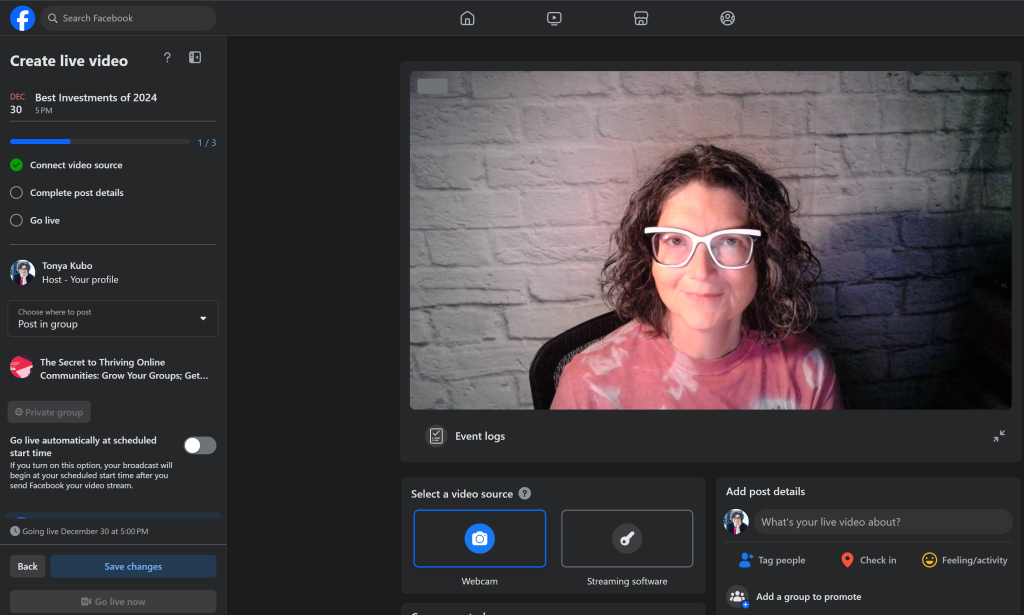
While Facebook Live Producer lacks the polish of third-party streaming services that support branded frames and lower-thirds for your livestream, it works well within Facebook groups, doesn’t cost a dime, and doesn’t require much technical skill or training.
Video Resources for Community Managers
They say a picture is worth a thousand words, but nothing compares to video when it comes to building meaningful relationships with people you have never met in real life.
Video helps to build deeper connections within communities because tone is hard to read via typed text. What is written with the intent of wry wit by one person can be perceived as judgmental, sarcastic and outright mean to another.
If you love video, you probably already have a favorite app or software program. For several years (2019 to 2024), I swore by StreamYard for live video streaming throughout social media. Since, their major price increase in 2024, that’s no longer the case.
Facebook’s decision to close its API for Groups in April 2024 reduced the value of third-party livestreaming apps for most community managers. Third-party apps are still the way to go for multi-streaming (livestreaming to multiple platforms at the same time) on public-facing properties (Facebook Page, YouTube Channel, LinkedIn Profile, etc.). But if livestreaming into your group is your top priority, the investment in a third-party application might not make sense.
Facebook Live Producer
Recommending Facebook Live Producer for livestreaming in Groups or elsewhere on Facebook is not something I thought I’d do again since the feature went wonky for me back in 2020. For two straight years, I couldn’t access the feature at all. But with the API closure, I had to learn to make it work – especially when testing consistency around going live every day.
The biggest benefits of Live Producer are that it’s free and easy to initiate from computer or mobile device.
Other benefits:
You can pin a comment to the top of the comments feed under your video (great way to highlight a call to action)
You can schedule your livestream in your group as an event
Issues I have with Live Producer:
You can’t have an on-screen guest if you livestream from your computer. To livestream with a guest, you must initiate the livestream from your phone. Your guest must be watching the livestream from their photo to request to join the broadcast or for you to invite them to join the broadcast with you. Sound annoying? It is.
You can’t toggle back and forth between direct-to-camera and screen share. If you want to share your screen for a tutorial, you must initiate that before the broadcast begins. This is the feature I miss the most with third-party apps.
Even if you type out a title and description before you go live, you have to do it again when you initiate the broadcast — and the formatting doesn’t stick. You have to edit the post after the livestream ends to add spaces between paragraphs and any other formatting you want.
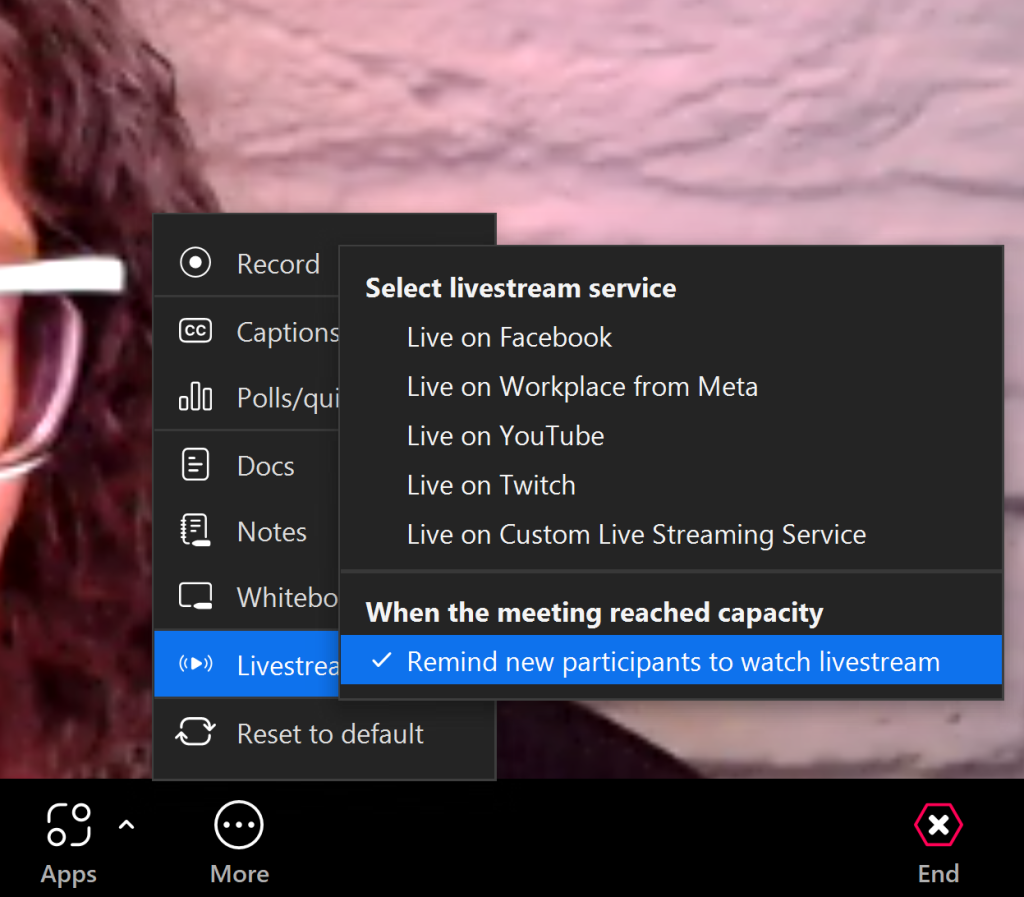
If you’re already paying for Zoom, explore its livestreaming options to see if they meet your needs. It’s fairly easy to connect Zoom to your Facebook Page, YouTube and Twitch channels. The “Custom Streaming Service” option will allow you to use RTMP to stream into a Facebook group.
Zoom
I don’t love using Zoom for livestreaming into Facebook groups, but if you want to stream from your computer, toggle back and forth between looking at the camera and sharing your screen, or having one or more people on camera with you, it’s a solid option.
I wouldn’t invest in a Zoom account strictly for livestreaming purposes but if you’re already paying to use it for meetings or webinars, learning to use it for livestreaming further maximizes your investment.
Going live to a Facebook Page, YouTube channel or Twitch account is as easy as connecting your accounts and clicking a button from within a meeting. But if you want to go live in your group, you’ll need to select the “Custom Streaming Service” feature, which uses RTMP to connect your Zoom meeting to a livestream within your group.
If production quality and audio/visual effects are important to you, check out OBS Studio. It’s free and if you’re willing to spend time learning how it works, it can do a lot for you.
Loom
The joke around here is that I speak fluent Loom, because I send so many videos using Loom. I’ll send direct-to-camera videos in response to emails I receive, and I record a lot of tutorials using Loom because the service is so easy to use. To date, I’ve recorded and shared almost 2,500 videos using Loom. Whether I’m offering feedback to a client, providing a tutorial or starting a conversation, Loom makes it easy to do from my phone and my computer.
Loom hosts your videos and tracks views while allowing viewers to leave comments as well. You can trim, edit and embellish your videos – all within the app. And, you can download your videos to upload to various platforms such as Facebook and YouTube.
In 2024, I tested Zoom Clips as a replacement for Loom to see if I could simplify my tech stack. While Zoom Clips was just as good at recording videos as Loom is, it falls short in additional features. What I have always appreciated about Loom is that I could also upload recordings to share with others. Zoom Clips lacks that capability. Zoom feels more like an internal recording tool, not one that’s meant for external audiences.
Email Marketing Services
Email marketing services allow you to send professional mass emails to your community members in compliance with anti-spam laws. Services like this are critical if you’re sending out newsletters, sales emails or are trying to build up an email list for business purposes.
But they are also a powerful way to connect with your online community members outside of your group, which is important if the community is hosted on social media. You never know when Facebook, LinkedIn or a similar platform will go down or be unavailable. I value having email access to my group members. In The Secret to Thriving Online Communities, we even have a specific email onboarding sequence that goes out to new members and establishes that direct line of communication.
Kit (formerly ConvertKit)
Kit has been around for AGES but has made significant advances in its level of service recently. I started using Kit in 2016 when I had only 45 email subscribers. I was frustrated by MailChimp and looking to make a switch. Even though they didn’t have a free plan at the time, Kit’s customer service and stability made them worth the investment. I’ve never looked back.
Nowadays, they have various tiers that work at just about any stage of business. The freemium plan is fully functional up to 300 subscribers. I’m seeing a lot of authors, podcasters and livestreamers go all-in on using Kit to connect with their audiences. It’s just as valuable for product-based business. They have great starter templates and a variety of features to allow you to customize your subscriber experience. They also have the Creator Network for collaborative list-building efforts. In 2024, 774 people subscribed to my email list through Creator Network referrals — making this the best passive list-building tactic I’ve ever tried.
What I’m especially excited about at the moment is the Kit App Store. Seamless integration with Canva, Giphy, Senja are streamlining my workflow. When you shop the App Store, make sure to look at “legacy integrations.” Community leaders will be thrilled to see integrations with Circle, Mighty, MemberPress and MembersPro.
Mailerlite
I don’t LOVE Mailerlite, but many of my clients do. Sadly, like a lot of email marketing services, they’ve dramatically reduced the value of their free account tier. So much so, I’m almost exclusively recommending Kit now. But if you prefer a simple interface and solid drag-and-drop builder (something Kit doesn’t do well), you should investigate Mailerlite.
Social Media Scheduling Tools for Community Managers
I’ve used at least 100 social media schedulers over the years. Between my work as a social media manager for a major research university, an agency owner, solopreneur and fractional CMO, I have put every tool through its paces. I believe most schedulers do one thing best or work with one platform best and do everything else “meh” — so get clear on your priorities before committing to any paid plan.
As a people-first community manager, I have a different perspective on social media schedulers. I don’t use them so I can “fix and forget” my social media plan. I use them to publish content when my audience is most apt to see it, so that my time is freed up to develop meaningful relationships across social media. By scheduling my posts, I can spend more time responding to comments and commenting on other people’s posts.
Meta Business Suite
Since Facebook closed its Groups API in April 2024, most third-party apps won’t auto-publish posts into your Facebook group. That makes native scheduling of content within your group and Meta Business Suite as your top two options for scheduling community content.
Meta Business Suite has finally integrated all content creation and scheduling tools to provide a pretty good level of service for scheduling to Instagram and Facebook, and moderating your comments. Best part? It’s still free.
The cost of free in this case is basic functionality. Here is what you can do through Business Suite:
Schedule posts to Facebook Pages, Groups, and Instagram accounts (including Reels, Stories and videos)
Schedule Carousels to Instagram
Customize the text of your post, so your caption on Facebook differs from your caption on Instagram when cross-posting
Get recommendations for the best times to post on Facebook and Instagram according to when your followers are most active
Access analytics on post performance (even if you didn’t schedule the post through Business Suite)
What you can’t do:
Schedule the first comment to publish with the post
In-depth hashtag research
Schedule content to platforms Meta doesn’t own
If your preferred social media platforms are owned by Meta, Business Suite might be all you need for scheduling your content at the moment.
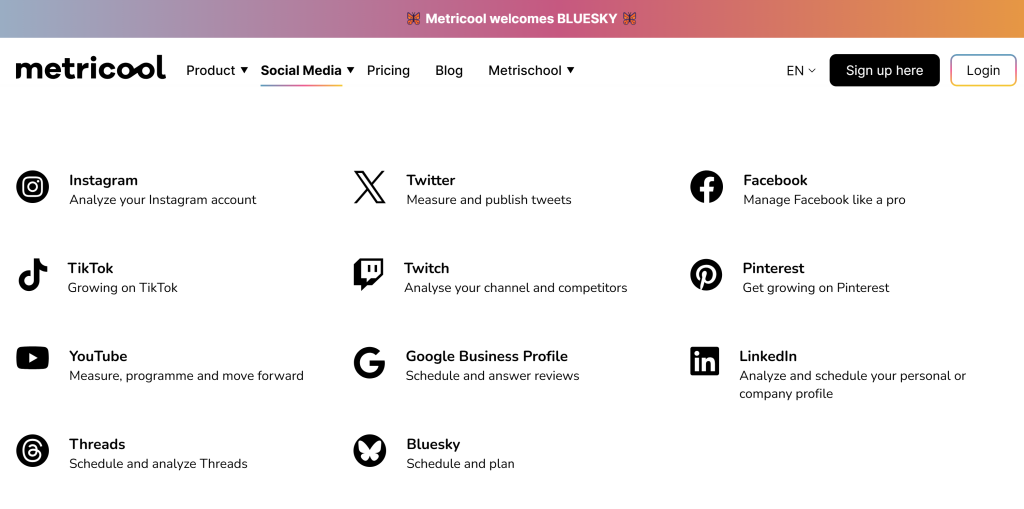
For the price, Metricool integrates with a robust list of social media platforms, including Instagram, TikTok, YouTube, Threads, Twitter (X), Twitch, Bluesky, Facebook, Pinterest, LinkedIn, and Google Business Profile.
Metricool
I switched from SmarterQueue to Metricool in Fall 2022 because I love the integrated dashboard that combines analytics from my website with all connected social media properties. I also find its scheduler to be more reliable, while still allowing for posts to be recycled on a loop.
I use the paid plan, which allows me to schedule to my LinkedIn profile. Unfortunately, analytics are only available for company pages on LinkedIn. I like that I can schedule both my post and the first comment on Facebook, Instagram, and LinkedIn. If you don’t have graphics or images of your own, you can access their image library to illustrate your posts. Recently they have added AI copywriting to help improve the quality of posts and direct integration with Canva and Google Drive to make accessing your own images even easier than before. In 2024, they added several platforms to the list of supported channels (e.g. TikTok, Threads, Bluesky, Pinterest).
Tailwind
If Pinterest is part of your marketing strategy, you need to take a close look at Tailwind. No service is better at executing an effective Pinterest strategy. I don’t care for how it manages scheduling to other platforms but if your brand is Pinterest-forward, it makes sense to fully embrace Tailwind as your social media scheduler.
Productivity Tools to Support Community Managers
As a service provider, I have a lot of experience with productivity tools. I’ve tried several personally and professionally. Whether they are tools my team and I use in our business, or tools our community management clients use in working with us, the choices are numerous.
I believe you are your most important system. The best productivity tool for you is the one that plays nicely with your brain. You may have to try a few to find the right fit for the work you do, but once you make a decision, the time saved is exponential.
News Feed Eradicator
If you find yourself distracted by the overwhelming amount of content on your social media timelines, News Feed Eradicator will be your best friend. This free Chrome Extension wipes your news feed clean, so you can focus on the task at hand. It works on every major social media platform, including Facebook, Twitter, YouTube, Instagram, Reddit, LinkedIn and more.
You can turn on the eradicator for a limited amount of time if you’re doing deep work on social media, or keep it on all the time to take control over your news feed.
GroupTrack CRM
My people-first approach to community management is made possible at scale thanks to GroupTrackCRM, which works on Facebook, Instagram and LinkedIn to keep track of conversations, ensuring nobody falls through the cracks.
We use GroupTrack for our high-touch member onboarding experience in The Secret to Thriving Online Communities, and I also use it to keep track of people I connect with all over Facebook (friends, page followers, peers, etc.). The bulk messaging feature allows me to stay in touch with people via DMs without landing in Facebook jail. GroupTrack is a great tool for anyone who wants to tighten up their process for cultivating leads via social media.
Basecamp
Basecamp is a web-based project management and collaboration tool that our team uses to manage work and communicate with our clients and each other. It offers a variety of features that can increase productivity, including task management, communication (direct messaging, group chats and message boards), file sharing and scheduling. Customize Basecamp by integrating it with other parts of your tech stack, like Proposify, Toggle, Timeshift Messenger and HoneyBadger.
Having one service to manage internal and external communication and project management has saved hours for my team. We’ve been able to eliminate weekly meetings and can now successfully achieve our goals by working asynchronous to one another. The functionality of the mobile app is just as convenient as the web app, critical for anyone who conducts business on the go.
Asana
Asana is a web-based project management tool that is designed to help teams organize and manage their work. Though you can view tasks as a kanban board, Asana is great if you’re a list person. It creates to-do lists, assigning tasks to team members, setting due dates and tracking progress.
Asana has been around so long that it integrates with most popular tech tools online business owners and community managers rely on. Slack, Microsoft Teams, Vimeo and Google’s suite of services are just a few. If you’re going to use Asana for project management, I strongly encourage you to add on Slack for internal communication. Otherwise, you’ll end up buried in meetings or email when you need to brainstorm ideas.
Slack
Slack is a cloud-based team communication and collaboration tool that provides real-time messaging, file sharing, and group chat features. It is designed to improve team productivity and streamline communication. Slack makes work easier by including all members of your team in discussions, regardless of locations.
The best remote teams I’ve been on use Slack for internal communication. I’ve also used Slack as a community platform. Not everyone likes Slack’s user interface, but if you take the time to organize your workspace in a logical manner, teach your team to use it effectively and hold everyone accountable to using it as designed, you’ll quickly come to love it. Slack integrates seamlessly with Zoom, Google, Asana, GIPHY and Loom (along with hundreds of other software resources).
Liz Wilcox’s Email Marketing Membership makes it easy to connect with members of the online communities you manage.
Courses, Memberships, Products and Programs
Community management isn’t just a matter of running a Facebook Group or two. To have a thriving online community, you need a variety of other skills: building and nurturing your email list, graphic design, video production, and an understanding of search engine optimization (SEO), online learning and content management. You can hire service providers to do these things for you or enroll in programs that help you do them yourself.
This is not an exhaustive list of the programs I credit for helping me to get to where I am, but they are programs that solve what I think are some of the biggest problems facing community managers.
Liz Wilcox’s Email Marketing Membership (EMM)
If you’re using your community for lead generation, you need a way to connect with them outside of the group. Email is the best way to reach your members. Getting their email address is the first step but once you have email addresses for your members, what’s next? Ideally, you’ll start emailing them regularly so they get used to hearing from you in both places. But it can be hard thinking of what to say in those emails.
Enter the Email Marketing Membership (EMM) by *NSYNC-loving Liz Wilcox. For only $9 per month, Liz will send you an email template and video explanation of how to use it every week. Her membership portal has a variety of workshops on how to grow your email list and turn followers into friends and clients. The membership includes a private Facebook community for team and peer support.
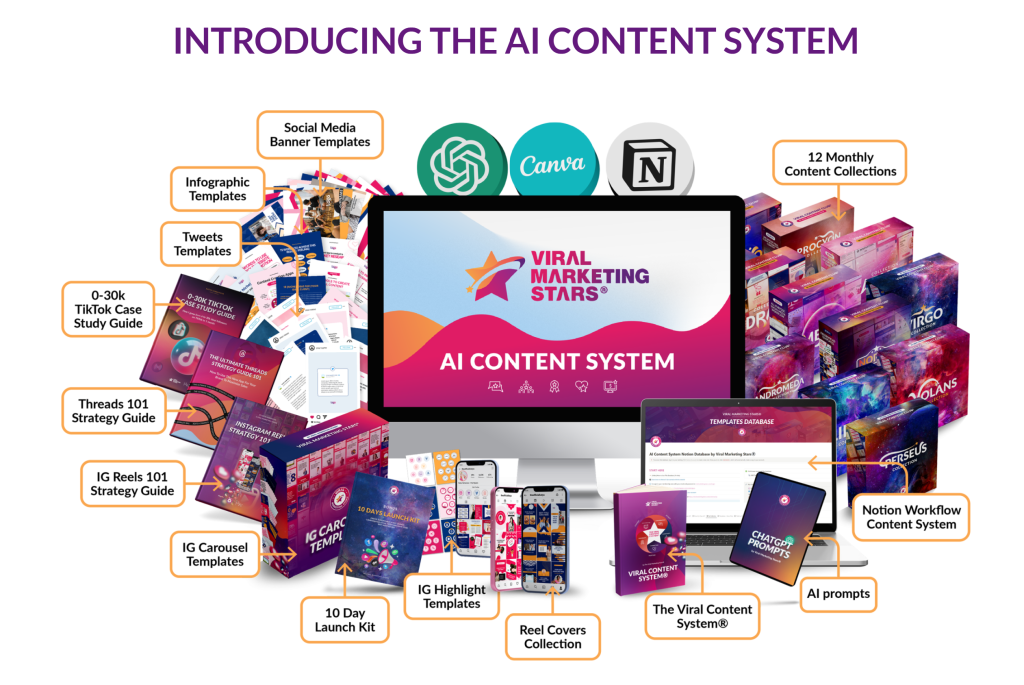
The AI Content System by Viral Marketing Stars includes the Viral Content System® Strategy, 12 Monthly Content Collections with templates, captions & calls to actions, AI Notion workflow with all the templates + captions + call to actions pre-loaded, AI ChatGPT prompts & step-by-step customization for your niche, and a variety of additional bonuses.
AI Content System (Viral Marketing Stars)
Design is not my gift but hiring a designer for social media content isn’t practical. Professionally designed graphics average $14 apiece. At that rate, a package of 15 images would cost $210. That’s a steep price tag for social media posts with an average shelf life of a few hours.
So how do you get compelling graphics to slow the scroll on social media without breaking the bank? The AI Content System from Viral Marketing Stars is my recommended solution. The Viral Content Club, a Canva template subscription, is my solution. I first entered the Viral Marketing Stars ecosystem in 2016 when I was first learning livestreaming from founder Katya Varbanova. Since then, I’ve leaned on Katya’s digital products for a variety of reasons. I still rely on these Canva templates for everything from Facebook cover images and Instagram posts to YouTube thumbnails and infographics.
OnVideo
This video membership is helpful if TikTok, Reels or YouTube Shorts are part of your marketing strategy. OnVideo is Elise Darma’s membership focused on short-form video content.
Every week, you get five short-form video ideas and caption templates for TikTok, Reels, Shorts and Idea Pins. They are adapted to a variety of business models, whether you sell coaching, services or products. These video ideas are also great if you’re looking for quick videos to post in your community.
The Playhouse
The Playhouse is a collective of creative solopreneurs that launched in 2024 with a simple goal: to help members expand their network and visibility in fun, collaborative ways.
The Playhouse is built on the foundation that we’re all leaders and learners. Mentors in our unique zone of genius, whether it’s business skills like design, copywriting, marketing, or life skills like body liberation, breathwork, or learning how your birth chart can affect your capacity.
As a Playhouse mentor, I host ask-me-anything and tutorial sessions each month. I have also built strong collaborative relationships with other members of the Playhouse. Even in the short few months I’ve been part of The Playhouse, I’ve found both service providers and clients from within the community.
What I enjoy most about The Playhouse is while there are several events hosted each month, none are recorded. This prioritizes live participation and makes each event truly special. The Playhouse is hosted on Heartbeat and events are hosted using GoBrunch. It’s a different experience, for sure, but one that is well-suited for anyone seeking human-to-human connection in their online business efforts.
Attract & Activate
I’ve been working with Meg Casebolt and the Love at First Search team since 2020. I’m an Attract & Activate alumna and I hire the team each year for an SEO Roadmap.
Attract & Activate, delivered live twice each year, is the first course that made search engine optimization and keyword research make sense to me. Once I understood how SEO worked, I also understood what a beast it can be to do well. Hiring Meg’s team for my annual SEO Roadmap means the heavy lifting is done by professionals. The team does the keyword research for me based on my goals for the year, and provides me with a list of keywords to target and articles to write to support ranking for those keywords. If you found this article from an online search, you have the proof of the Love at First Search team’s success.
Additional Resources for Online Community Managers
Canva
Canva is a web-based graphic design platform that allows users to create a wide range of visual content, including social media graphics, presentations, posters, flyers, videos, and more. The interface is user-friendly and the template options are vast. Even with no design experience, you can create professional graphics quickly and efficiently.
Canva was one of my earliest business investments, and it gets better every year.
Google Workspace
Most community managers aren’t working deeply under the hood of the businesses they support, but sometimes our work with clients identifies deeper operational issues that need fixing so we can be most effective. Though it doesn’t happen often, I’ve worked with clients who have achieved significant business success without fully building out business systems. These clients, usually solopreneurs (maybe supported by a VA), are running their business through a personal email account and free cloud storage.
In these situations, I recommend Google Workspace’s Business Starter or Standard Plan. I use the Standard Plan because my work requires the 2TB pooled storage and the included Appointment Bookings Calendar and eSignature with Docs and PDFs have allowed me to cancel my Calendly and Adobe subscriptions. Google Workspace is a robust suite of tools that supports professional communications, scheduling, and data storage and management. And if you want to fully appreciate all that Google has to offer you and your business, I highly recommend Adrienne Farrow’s Go-To Community. Adrienne is my personal Google expert and the reason I’ve been able to streamline my tech stack.
MemberVault
When I launched my first online course in 2018, I looked everywhere for an easy, affordable learning management system. MemberVault caught my eye because it was the first to offer a marketplace dashboard that displayed free and paid offers side-by-side.
You can use it for coaching, consulting, courses, memberships, digital products, and even podcasts. I’ve tried other LMS platforms over the years but keep returning to MemberVault. Nothing compares to the value at this price.
Want Help Choosing Community Management Resources?
Team Kubo specializes in online community design, development and growth. Whether you need help with strategy, training your admin team or day-to-day management of your group, we can help. The first step is to complete our no-cost community health assessment, so we can identify your needs and customize a plan to get the results you desire.
Not only are we seeing a renaissance in online community-building, we’re seeing disruption in the marketplace.
Consumers are tired of emotionally manipulative marketing tactics.
Whether you call it “dude-bro marketing” or “bully marketing,” the sentiment is the same: We’re all tired of being convinced that a one-size-fits-all solution is going to make us money while we sleep.
I first saw the shift among consumers.
First, people started to question the free “trainings” that taught the “what” and “why” of a problem but dangled the “how” like a carrot with a very juicy price tag attached.
But they still handed over their credit and debit cards because what choice did they have?
This is how business was done.
Offer after offer was snapped up. During the pandemic, aspiring entrepreneurs hit the “buy” button like never before. Online marketers had their best year ever, some launches tripled their revenue projections.
And then what happened? Not much.
Pre-pandemic business tactics quickly floundered in our post-pandemic society.
On the other side of the fence, online business owners felt the shift as well.
As the market flooded with online programs and “make money while you sleep offers,” it was hard to ignore the predatory messages.
I compare it to death by a thousand paper cuts. After the first 50, you no longer feel the sting. But they all bleed just the same.
A steady flow of funnel-based marketing emails here and there don’t attract much attention. But when your inbox is suddenly filled with hundreds following the same “problem-agitation-solution” framework and adrenaline-triggering “act-now” bonuses, you can’t help but see all the blood pooling from those thousand paper cuts.
And though I can’t speak for others, my business besties all had the same observation: People who invest in programs with regulated nervous systems tend to have more success than those who buy when in the midst of fight-or-flight mode.
For the past year, I’ve been actively looking for others who see what I see and seeking those who are ready to do something different.
One of the leaders who have emerged is Sophie Lechner, a LinkedIn strategist who believes you can be successful at getting clients without becoming a salesy weirdo in anyone’s DMs.
That’s why I’m participating in Sophie’s Marketing Mutiny, a month-long conversation on LinkedIn about doing marketing differently. Specifically, the 10 business owners participating are sharing values-based marketing tactics that are working right now.
Obviously, I’m talking about online communities. Others, though, are talking about intentional one-to-one conversations, free office-hours sessions and other approaches that are on brand, heart-centered and – most importantly – get results.
Because we all know there is no such thing as a one-size-fits-all solution, my hope isn’t that you’ll walk away from Marketing Mutiny with 10 new strategies to explore. My hope is that each participant choose one that either layers on top of what is already working or replaces what’s not.
Click here to find out more about the program, which runs the whole month of April.
I love cats. I’m one of those people who can lose myself in an endless loop of videos featuring babies, animals, and Starbucks hacks. No. I don’t ever try to make the copycat drinks myself, but I enjoy watching other people do it.
But as someone who “Facebooks for a living” I can’t afford hours of doom-scrolling. I need to get in, do what needs doing, and duck out to focus on other things.
Whenever someone asks how I can manage multiple communities on multiple platforms at the same time, I always say I am forced to focus. Especially on Facebook, where there are hundreds of notifications and updates vying for my attention every time I log in.
So yes, I do focus my time on social media. I also have help.
My help is in the form of a handy Chrome extension called the News Feed Eradicator. You have to see this tool in action, especially after the major updates made over the past two years. It’s my best ally in making social media a distraction-free zone.
The video above is 9 quick minutes, but you can always speed it up if you’re running short on time. After you watch it, leave a comment sharing which feature impresses you most. I can’t wait to see what you think!