
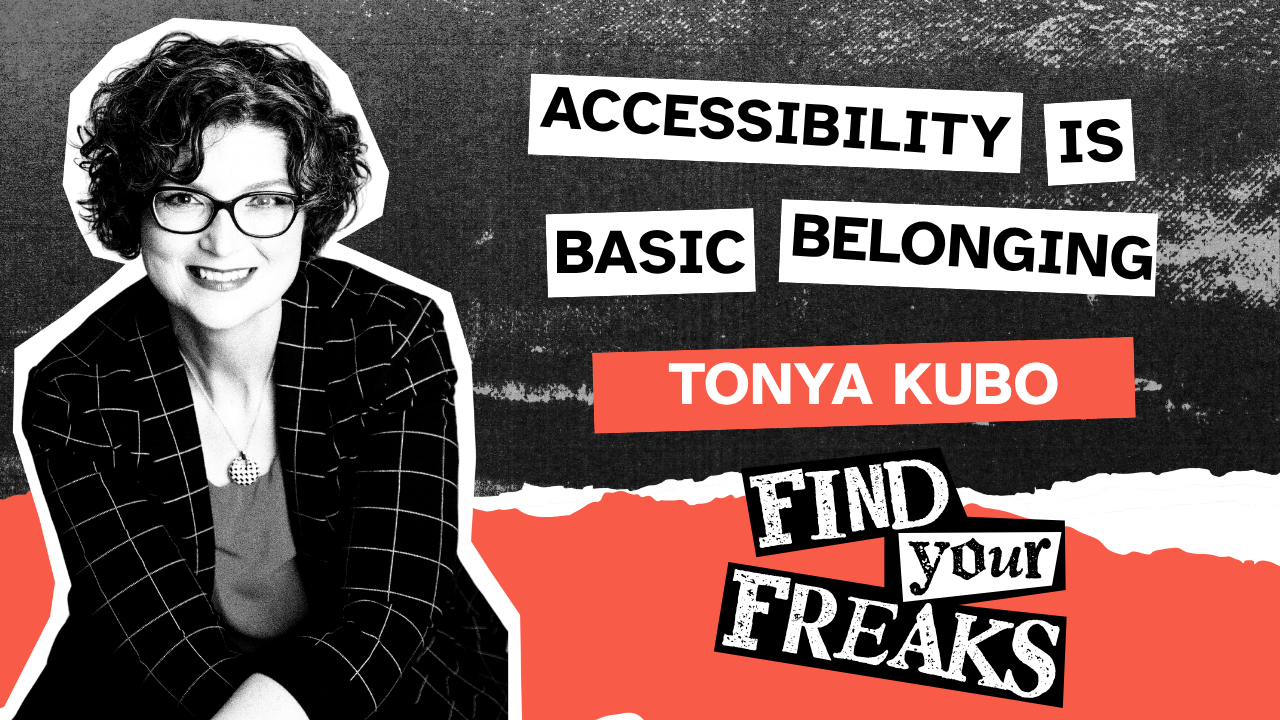
Why reducing cognitive load creates communities where more people can participate, connect, and thrive
Accessibility is often treated like a technical requirement. Add captions. Upload a transcript. Check the compliance box and move on. But what if accessibility is actually one of the clearest ways we communicate care?
In this episode of Find Your Freaks, Tonya Kubo builds on her conversation with Dr. Catrina Mitchum to explore a bigger idea: accessibility is not just about helping people get in the door. It is about making it possible for them to fully participate once they arrive. Whether you’re leading an online community, creating a course, facilitating a workshop, or hosting an in-person event, every design choice either lowers barriers or quietly creates new ones.
Through stories, practical examples, and a fresh perspective on cognitive load, Tonya challenges listeners to think beyond compliance and toward belonging. Because when people feel considered, they feel connected. And when they feel connected, communities become places where everyone has the opportunity to contribute and thrive.
Episode Highlights
- [01:10] Why accessibility is about removing friction, not checking boxes
- [05:00] How cognitive load shapes the way people learn and participate
- [09:30] Why transcripts, captions, and multiple learning formats benefit everyone
- [13:50] The problem with putting accessibility behind a paywall
- [17:45] Three questions every course creator and community leader should ask
- [21:20] How offering multiple ways to participate strengthens belonging
- [25:00] Why accessibility is ultimately an act of care
Accessibility Is More Than Compliance
Most conversations about accessibility begin with technology. We think about captions, transcripts, alt text, or screen readers. Those tools matter, but Tonya argues they’re only part of the story.
Real accessibility is about reducing unnecessary friction. It’s asking whether someone can easily understand, participate in, and apply what they’re learning rather than simply asking whether they can technically access the information.
A workshop activity, an online lesson, or even a room full of chairs can unintentionally create barriers that make people spend more energy navigating the experience than engaging with it. Every extra decision, every confusing instruction, and every unnecessary obstacle adds cognitive load that pulls people away from learning and connection.
027 – Accessibility Is Basic Belonging Share on X
Designing for the Experience You Want People to Have
One of the biggest takeaways from this episode is that accessibility starts long before someone arrives.
Rather than beginning with content, Tonya encourages leaders to start with intention. What is the goal of this lesson, event, or activity? What does success actually look like for the participant? Once those answers are clear, every design decision becomes easier to evaluate.
She offers three simple questions that can transform the way we build communities and educational experiences:
- What is the goal?
- Who might be left out?
- What small change could make this easier for everyone?
Those questions shift accessibility from a reactive checklist to a proactive mindset, creating experiences that serve a wider range of people without sacrificing quality.
027 – Accessibility Is Basic Belonging Share on X
Lowering Cognitive Load Helps Everyone
Throughout the episode, Tonya returns to one idea over and over again: making something easier for one person almost always makes it better for everyone else.
Captions help someone watching in a noisy coffee shop. Transcripts help someone who processes information by reading. Explaining the purpose behind an exercise helps neurodivergent learners, but it also helps every participant understand expectations and take action with confidence.
Offering multiple ways to engage, whether that’s writing, recording a voice note, drawing a picture, or joining a discussion, creates more entry points for learning instead of forcing everyone into the same experience.
Accessibility is not about creating special accommodations for a select few. It is about recognizing that people learn, process, and participate differently and designing with that reality in mind.
027 – Accessibility Is Basic Belonging Share on X
Belonging Should Never Cost Extra
Tonya also addresses a practice that continues to surface in online education: putting accessibility behind a paywall.
Charging extra for transcripts, captions, or other basic access tools sends an unintended message that some people have to pay more simply to receive the same experience as everyone else. While technology has made accessibility easier and more affordable than ever, some creators still treat it as a premium feature instead of a baseline expectation.
The conversation moves beyond legality or compliance and into community values. If belonging is truly the goal, then access cannot be reserved for those who can afford an upgrade.
Communities become stronger when people are invited to participate fully from the beginning, not when they have to purchase their way into an equivalent experience.
027 – Accessibility Is Basic Belonging Share on X
Care Is What Creates Connection
The most powerful idea in this episode is also the simplest.
Accessibility is an expression of care.
It’s choosing chairs that welcome more bodies. It’s explaining why an activity matters before asking people to invest their time. It’s providing multiple ways to learn and participate. It’s thinking about someone’s experience before they ever enter the room.
Those choices communicate something bigger than convenience. They tell people, “I was thinking about you.”
And when people feel considered, they are more likely to feel connected. They stay longer, contribute more freely, and help create communities where others feel welcome too.
Belonging doesn’t happen by accident. It grows through countless intentional decisions that make participation easier and connection more possible.
027 – Accessibility Is Basic Belonging Share on X
Three Questions I’m Sitting With
- Where am I unintentionally creating barriers for the people I want to serve?
- What small change could make participation easier for everyone?
- How can I design my communities and experiences with care instead of assumption?
Meet Your Host
Tonya Kubo is a community strategist, writer, and rebel with a cause: helping people find the place where they truly belong. She’s spent nearly two decades building online spaces that feel more like chosen family than comment sections, and she’s not afraid to call out the fluff in favor of real connection. As the founder of Find Your Freaks, Tonya brings together unconventional thinkers, builders, and bridge-makers who believe that “normal” was never the point. When she’s not hosting the show, she’s raising two daughters, leading client communities, and making meaning out of the mess.
Episode Transcript
Get the full transcript from Episode 027.
Resources & Mentions
- Episode 026 – Interview with Dr. Catrina Mitchum
Support the Show
If Find Your Freaks matters to you, help us keep it ad-free by sharing the episode, leaving a review, or sending it to someone who has been searching for their people.
Let’s Stay Freaky
What’s Next
Next time, Tonya sits down with Alicia Shidler to explore what it means to live with radical intention. Together, they unpack choosing purpose over expectations, building a life anchored in what matters most, and why being a good parent doesn’t mean losing yourself along the way.

0 Comments