
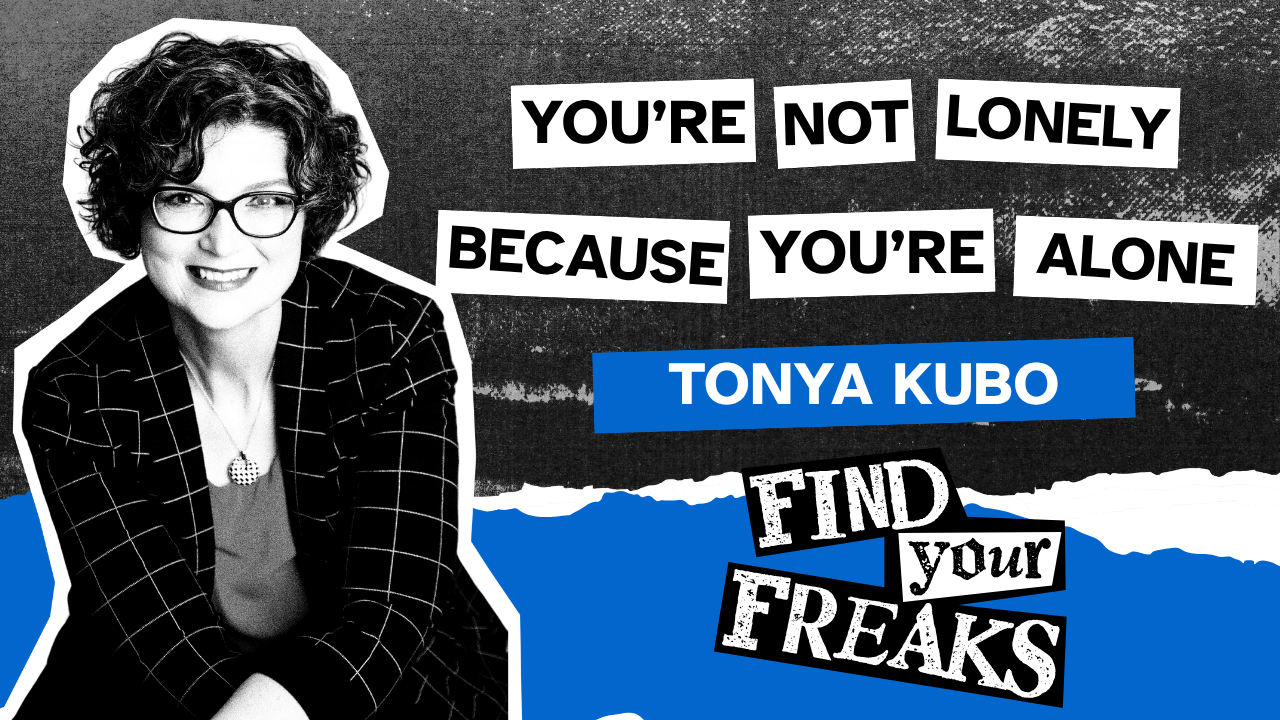
Why belonging is built through alignment, not proximity
Loneliness is often treated like a numbers problem. Make more friends. Attend more events. Fill your calendar, and the loneliness will disappear. But what if being surrounded by people isn’t the same as belonging?
In this episode of Find Your Freaks, Tonya Kubo builds on her conversation with Alicia Shidler to explore a different perspective: belonging isn’t about proximity—it’s about alignment. Through Alicia’s journey from California to rural Michigan, Tonya examines what happens when you stop measuring connection by how many people are around you and start measuring it by how deeply you’re understood.
Through personal stories, reflections on intentional living, and practical lessons from both online and in-person communities, Tonya challenges listeners to rethink what it means to find their people. Because the communities where we truly belong aren’t always the ones closest to us. They’re the ones where we can finally stop pretending to fit in.
Episode Highlights
- [01:12] Why loneliness isn’t simply a numbers problem
- [04:05] Alicia’s move to Michigan and how alignment replaced proximity
- [07:50] What Tonya’s front yard garden revealed about other people’s assumptions
- [11:40] Why intentional living often makes others uncomfortable
- [15:05] Online communities aren’t a consolation prize—they’re often where belonging begins
- [18:45] What healthy communities do differently to create trust and safety
- [22:15] Why silent community members may be paying the closest attention
- [25:20] Finding your people by living authentically
Belonging Isn’t About Being Surrounded by People
One of the biggest misconceptions about loneliness is that it can be solved by simply adding more people to your life. More invitations. More conversations. More social activity.
But as Tonya explains, loneliness isn’t created by physical distance. It’s created when we don’t feel understood.
Alicia’s story illustrates this perfectly. Although she lived near family and lifelong friends for years, she often felt disconnected because the life she wanted—homesteading, growing food, and making intentional choices for her family—wasn’t something the people around her truly understood. It wasn’t until she built a life aligned with her values that she found the kind of belonging she’d been searching for.
029 – You’re Not Lonely Because You’re Alone Share on X
Living Intentionally Won’t Make Sense to Everyone
Choosing a life that’s different from what’s expected often invites questions, criticism, or confusion.
Tonya shares her own experience of converting her suburban front yard into a community garden with her daughter. Rather than celebrating the vision behind the project, many people immediately focused on what might go wrong. Their reactions weren’t really about the garden—they reflected their own assumptions and fears.
That’s one of the quiet challenges of intentional living. Sometimes simply choosing a different path becomes a mirror for the people around you.
But as Alicia demonstrated, belonging doesn’t come from convincing everyone to understand your choices. It comes from finding people who already share your values.
029 – You’re Not Lonely Because You’re Alone Share on X
Online Communities Can Be Real Communities
There’s a persistent belief that online communities are somehow less meaningful than in-person ones.
Tonya challenges that assumption.
For Alicia, online communities became the place where she found practical advice, encouragement, and people who understood the journey she was beginning long before she ever moved across the country. Meanwhile, her local community became invaluable for the hands-on support that only neighbors could provide.
Rather than competing with each other, online and in-person communities often serve different purposes. One provides specialized knowledge and shared identity. The other offers practical support and local connection.
Belonging isn’t determined by where people are located. It’s determined by whether they understand who you are.
029 – You’re Not Lonely Because You’re Alone Share on X
Healthy Communities Are Built on Trust
Drawing from both Alicia’s experiences and her own work as a community strategist, Tonya explores what separates thriving communities from overwhelming crowds.
The healthiest communities share several characteristics:
- Clear purpose
- Consistent moderation
- Searchable resources
- Shared expectations
- Psychological safety
When leaders consistently protect those values, members learn they can participate without fear. When rules are applied inconsistently or harmful behavior goes unchecked, trust quickly erodes.
Community isn’t created by gathering people together. It’s created by cultivating an environment where people feel safe enough to stay.
029 – You’re Not Lonely Because You’re Alone Share on XThe Quietest Members May Be Watching the Closest
One of the most powerful insights from this episode is that participation isn’t the only measure of engagement.
Many people join communities quietly. They observe. They search. They read conversations before ever introducing themselves. They’re deciding whether the space feels safe enough to invest their time and energy.
That means every interaction matters.
Leaders aren’t simply communicating with the people who comment. They’re communicating with everyone who’s watching.
Consistency, integrity, and follow-through tell silent members whether the community truly lives up to what it promises.
029 – You’re Not Lonely Because You’re Alone Share on X
Belonging Starts with Being Yourself
The thread connecting Alicia’s story, Tonya’s reflections, and every community discussed in this episode is surprisingly simple.
You find your people by becoming more yourself—not less.
Authenticity won’t guarantee everyone understands you. In fact, it may make some people uncomfortable. But it also makes it possible for the right people to recognize you.
Belonging isn’t something another person hands you.
It’s something you create by living in alignment with your values and allowing the people who share them to find you.
029 – You’re Not Lonely Because You’re Alone Share on X
Three Questions I’m Sitting With
- Where am I confusing proximity with genuine belonging?
- What values am I building my life around, and do my relationships reflect them?
- How can I create spaces where people feel safe enough to be fully themselves?
Meet Your Host
Tonya Kubo is a community strategist, writer, and rebel with a cause: helping people find the place where they truly belong. She’s spent nearly two decades building online spaces that feel more like chosen family than comment sections, and she’s not afraid to call out the fluff in favor of real connection. As the founder of Find Your Freaks, Tonya brings together unconventional thinkers, builders, and bridge-makers who believe that “normal” was never the point. When she’s not hosting the show, she’s raising two daughters, leading client communities, and making meaning out of the mess.
Episode Transcript
Get the full transcript from Episode 029.
Resources & Mentions
- Episode 028 – What If It’s Not Normal… But It Works? with Alicia Shidler
- Sustaining Humanity by Phil McKay
Support the Show
If Find Your Freaks matters to you, help us keep it ad-free by sharing the episode, leaving a review, or sending it to someone who has been searching for their people.
Let’s Stay Freaky
What’s Next
Next time, Tonya sits down with Jen Mackinnon to explore what it means to belong in two worlds at once. Together, they unpack the unique challenges of balancing career and homeschooling, building community at the intersection of both, and why choosing a practical path doesn’t mean settling for less—it means creating a life that works for your family.


0 Comments